
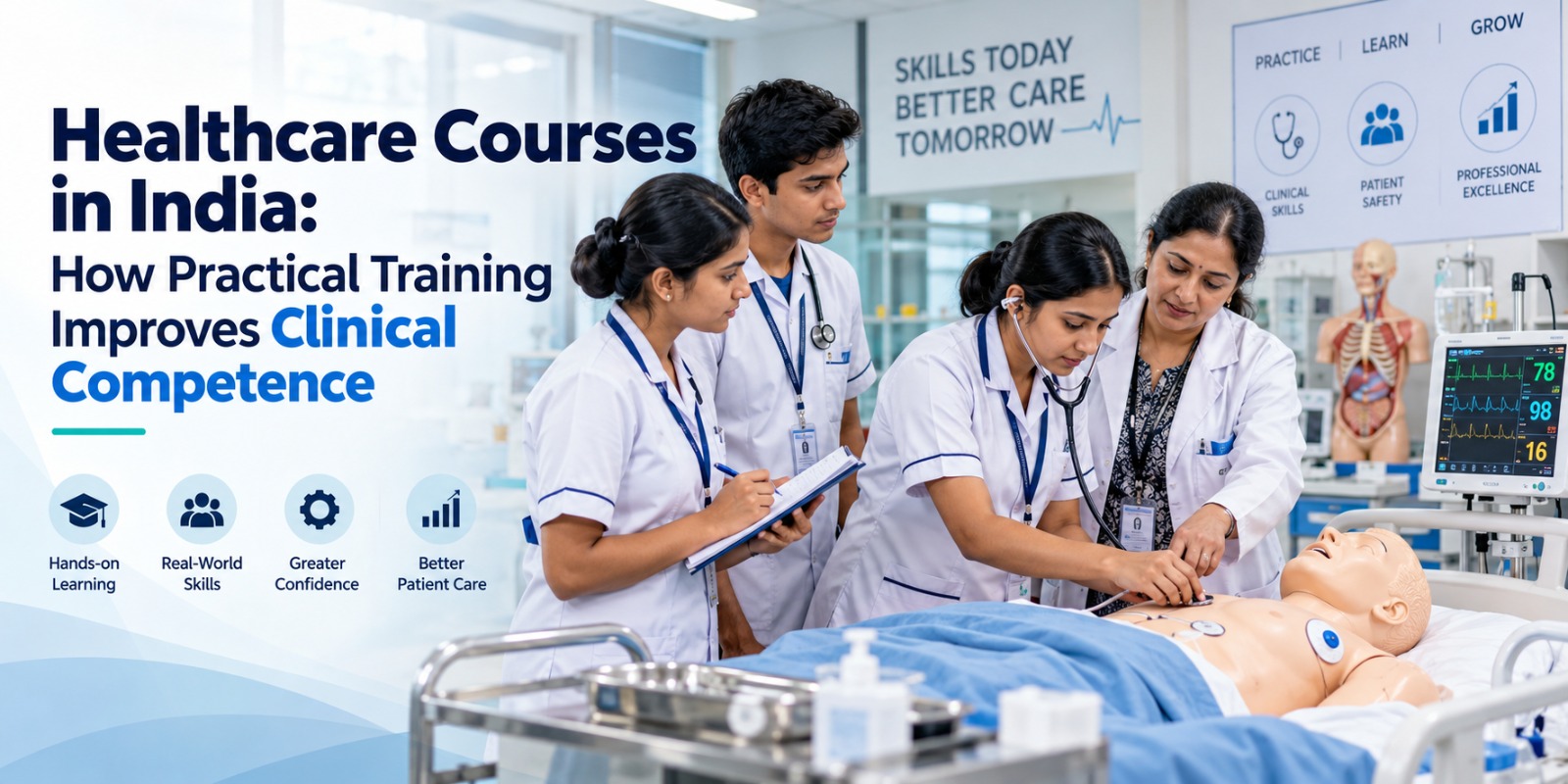
Safe and effective patient care requires not only theoretical knowledge but also the development of practical skills, knowledge, and understanding. They should also be able to apply what they have learnt in clinical environment, use proper equipment, adhere to safety guidelines and interact with other health care workers. This is a significant component of healthcare education that involves hands-on experience. Healthcare Courses in India are the courses in which students learn the skills and knowledge needed for various Healthcare related professions and are also given practical training under supervision.
Bridge the Gap between Theory and Practice
Students gain knowledge of medical concepts, procedures and principles of patient care through textbooks and classroom sessions. But putting this into practice in real life situations requires more preparation.
Practical sessions will enable students to get familiar with clinical procedures, equipment, and responsibilities at a work place. For instance, in anaesthesia technology, students will gain knowledge about anaesthetic workstations and breathing circuits, and in critical care, they will practice vital signs monitoring and interpreting patient changes.
The mix of theory and practice supports students in gaining insight into the relationship between knowledge and daily competences. It also provides them with chances to fill in the gaps in their knowledge and to develop their skills in a suitable way, with proper guidance.
Teaching and Learning Essential Clinical Skill
Several competencies that are used in healthcare professionals’ daily activities are developed through practical training.
Handling of equipment: Students are taught the purposes, operation and safety procedures for appropriate medical equipment, under supervision.
Patient assessment: Training will enable the learner to observe the patient and to record his/her vital signs and identify information that needs further investigation.
Infection prevention: Demonstrations and exercises help reinforce hand hygiene, equipment cleaning, and other measures that help prevent HAI.
Emergency preparation: Simulations may help to train students for handling clinical emergencies, procedures, and communication about issues in time.
Documentation and teamwork: Practical training will familiarize the students with the significance of keeping proper documentation and working in a team.
These skills are relevant to safe working practice and are important in preparing students for practice in clinical settings.
The purpose of this program is to help students develop confidence through supervised clinical exposure.
Transitions from the classroom to a hospital can be difficult for students who are not used to working in a hospital environment. Supervised training offers the opportunity to watch expert practitioners, perform acceptable activities and be given feedback.
There is more advantage of simulation labs because in these setups, students can practice safely before experiencing the same in a clinical setup. If incorporated in the training programme, hospital-based training provides additional experience of work practices, equipment, patient work and professional duties.
Supervision quality is important. Pupils should be aware of their boundaries and only undertake clinical activities when they are suitably trained and authorised to do so. Competence should be developed in practice without compromising patient safety.
Selecting suitable Healthcare Course in India
Students should not just consider what the course is and how long it lasts when they look at the various healthcare courses in India. The curriculum should be supplemented with practical courses relevant to the subject matter, and availability of appropriate equipment, faculty and training opportunities.
The requirements for eligibility, accreditation/recognition (where applicable), assessment methods, and supervised placement availability should also be checked. Applications should be made for programmes in keeping with the student’s ability, interests and future occupations.
Conclusion
Practical training can help bridge the gap between theory and practice, enabling health care workers to apply their knowledge in real-world settings. Supervised learning helps students develop the skills they need for their chosen career path, from handling equipment to preventing infection to monitoring patients and collaborating with others. There are many healthcare courses in India, and by exploring those, the student can evaluate the practical facilities, clinical experience, and overall quality of the program.


