
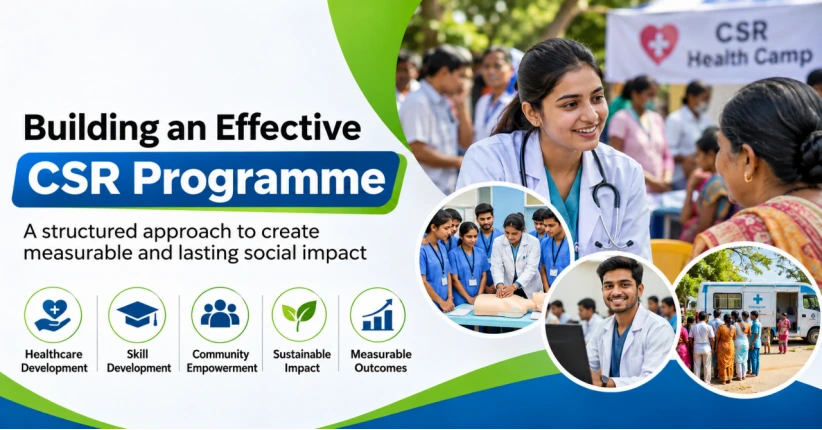
Corporate Social Responsibility (CSR) has become an important part of responsible business development. Companies are increasingly investing in initiatives that address social challenges, improve healthcare accessibility, promote education and create employment opportunities. However, the success of these initiatives depends on how effectively they are designed and implemented.
An effective CSR programme is a structured initiative that addresses specific community needs through strategic planning, resource allocation, implementation and impact measurement. Rather than focusing only on financial contributions, it encourages businesses to create meaningful and sustainable social outcomes.
What Is a CSR Programme?
A CSR programme is an organised set of activities undertaken by a company to contribute towards social, economic or environmental development. These programmes may focus on healthcare, education, vocational training, women empowerment, environmental sustainability and rural development.
A well-designed programme connects corporate objectives with the actual needs of communities. It establishes clear goals, identifies beneficiaries and develops a framework for evaluating results. Unlike isolated charitable activities, structured CSR programmes focus on long-term development, accountability and continuous improvement.
Why Should Businesses Focus on Measurable Social Outcomes?
Financial investment alone does not determine the success of corporate social responsibility activities. Businesses must also understand whether their contributions are creating positive changes in the lives of beneficiaries.
- Understand the effectiveness of social investments.
- Identify gaps in project implementation.
- Improve transparency and accountability.
- Strengthen stakeholder confidence.
- Allocate resources more effectively.
- Support long-term community development.
For example, a healthcare training programme should not measure success only through the number of participants enrolled. It should also assess course completion, practical competencies and employment outcomes.
Steps to Develop an Effective CSR Programme
1. Identify Community Needs and Development Challenges
The foundation of a successful CSR initiative begins with understanding the challenges faced by the target community.
Different communities have different requirements. Rural populations may experience limited access to healthcare facilities, while economically disadvantaged youth may require vocational training and employment support.
Businesses can conduct community surveys, interact with local stakeholders and consult implementation partners to identify priority areas. A needs-based approach ensures that CSR resources are directed towards meaningful interventions rather than activities that may have limited relevance to beneficiaries.
2. Establish Clear and Achievable Objectives
Every CSR programme should have defined objectives that guide implementation and evaluation.
For instance, a healthcare-focused initiative may aim to improve preventive health awareness, strengthen the skills of healthcare professionals or increase access to screening services.
Objectives should be specific, realistic and measurable. Establishing timelines, expected outcomes and beneficiary targets helps organisations monitor progress throughout the project. Clear objectives also allow implementation teams to understand their responsibilities and work towards common development goals.
3. Select a Suitable CSR Implementation Partner
Selecting an appropriate partner for CSR implementation is essential for translating corporate commitments into practical community development initiatives.
Businesses should evaluate potential partners based on their experience in relevant development sectors, understanding of community requirements, project management capabilities, qualified professionals and field-level teams, monitoring and reporting systems, and applicable registration and compliance credentials.
A well-structured CSR partnership can help businesses access specialised expertise, strengthen community engagement and improve project execution.
4. Develop a Detailed Implementation Framework
Once the objectives and implementation partner have been identified, businesses should prepare a structured execution plan.
The framework should define project activities, timelines, financial requirements, responsibilities, beneficiary selection criteria and monitoring mechanisms. The CSR implementation cycle provides further context for this process.
For example, a healthcare vocational training initiative may include candidate identification, classroom learning, practical training, competency assessments and employment assistance. A detailed implementation framework reduces operational uncertainty and helps ensure that activities remain aligned with the intended outcomes.
How Healthcare-Focused CSR Programmes Create Social Impact
Healthcare and community development are important areas of social development, particularly in communities where access to medical services, trained professionals and preventive healthcare remains limited. A healthcare-focused CSR programme can support communities through several approaches.
Healthcare Skill Development
Vocational training programmes can provide economically disadvantaged youth with practical healthcare skills. By connecting training with industry requirements, these initiatives can improve employability while supporting healthcare workforce development.
Community Health Camps
Community health camps can improve access to preventive screenings, health education and referral services. Such initiatives are particularly relevant for underserved populations facing barriers to regular healthcare services.
Healthcare Workforce Upskilling
Training existing healthcare professionals can help strengthen clinical competencies, patient safety awareness and healthcare service quality.
Mental Health Awareness
School and community-based awareness programmes can encourage conversations around emotional well-being, stress management and mental health challenges.
Rural Healthcare Development
Capacity-building initiatives can support healthcare facilities in improving operational processes, service quality and patient care practices.
Together, these interventions can contribute towards healthier communities and more inclusive development.
How to Measure the Success of a CSR Programme
Impact measurement allows businesses to understand whether their CSR activities are delivering the intended benefits. Organisations should distinguish between project outputs and social outcomes.
| CSR Focus Area | Project Output | Expected Social Outcome |
| Healthcare training | Number of participants trained | Improved skills and employability |
| Health camps | Number of people screened | Improved awareness and access to referrals |
| Women empowerment | Number of women enrolled | Greater economic participation |
| Mental health awareness | Number of sessions conducted | Improved understanding of emotional well-being |
| Rural healthcare | Number of facilities supported | Improved healthcare processes and service quality |
Businesses can use baseline assessments, beneficiary feedback, progress reports and post-programme evaluations to assess these outcomes. Regular monitoring also helps identify areas requiring improvement and supports informed decisions regarding future CSR investments.
Ensuring the Long-Term Sustainability of CSR Projects
A successful CSR programme should aim to create benefits that continue beyond the initial funding period. Long-term sustainability requires community participation, local capacity building and effective coordination between stakeholders.
For example, training local healthcare workers can help strengthen healthcare delivery even after a specific training initiative concludes. Similarly, vocational skill development can provide beneficiaries with competencies that support future employment opportunities. Businesses should consider sustainability from the planning stage rather than treating it as an additional activity at the end of the project.
How Astron Institute of Social Sciences Supports CSR Programmes
Astron Institute of Social Sciences (AISS) supports organisations in developing healthcare-oriented social initiatives and community development programmes. Its focus areas include vocational healthcare education, professional upskilling, preventive health outreach, emergency preparedness education and strengthening healthcare delivery in underserved areas.
Through project planning, implementation assistance and evaluation, AISS helps businesses connect their social responsibility objectives with community development requirements.
Conclusion
An effective CSR programme requires more than financial contributions and short-term charitable activities. It involves understanding community needs, setting measurable objectives, selecting appropriate implementation partners and evaluating long-term outcomes.
By focusing on healthcare, skill development and community empowerment, businesses can contribute towards inclusive social progress while strengthening accountability in their CSR initiatives. A structured and outcome-oriented approach enables organisations to transform their corporate social responsibility commitments into meaningful development opportunities.
Partner with Astron Institute of Social Sciences
Looking to develop a structured CSR programme focused on healthcare, skill development or community empowerment? Connect with Astron Institute of Social Sciences to explore need-based CSR initiatives, implementation support and measurable social development opportunities.
Frequently Asked Questions
What is a CSR programme?
A CSR programme is a structured corporate initiative designed to address social, economic or environmental challenges. It involves planning, implementation and evaluation of activities that contribute to sustainable community development.
How can companies develop an effective CSR programme?
Companies can develop an effective CSR programme by identifying community needs, defining measurable objectives, selecting suitable implementation partners and regularly evaluating project outcomes.
What are the main components of a successful CSR programme?
The main components include needs assessment, strategic planning, resource allocation, stakeholder engagement, project implementation, monitoring, impact evaluation and sustainability planning.
How can CSR programmes support healthcare development?
CSR programmes can support healthcare development through vocational training, preventive health camps, community awareness, healthcare workforce upskilling and improvements in rural healthcare delivery.
How does Astron Institute of Social Sciences support CSR implementation?
Astron Institute of Social Sciences supports healthcare-focused CSR initiatives through project planning, community-based interventions, skill development, implementation assistance and outcome evaluation.