
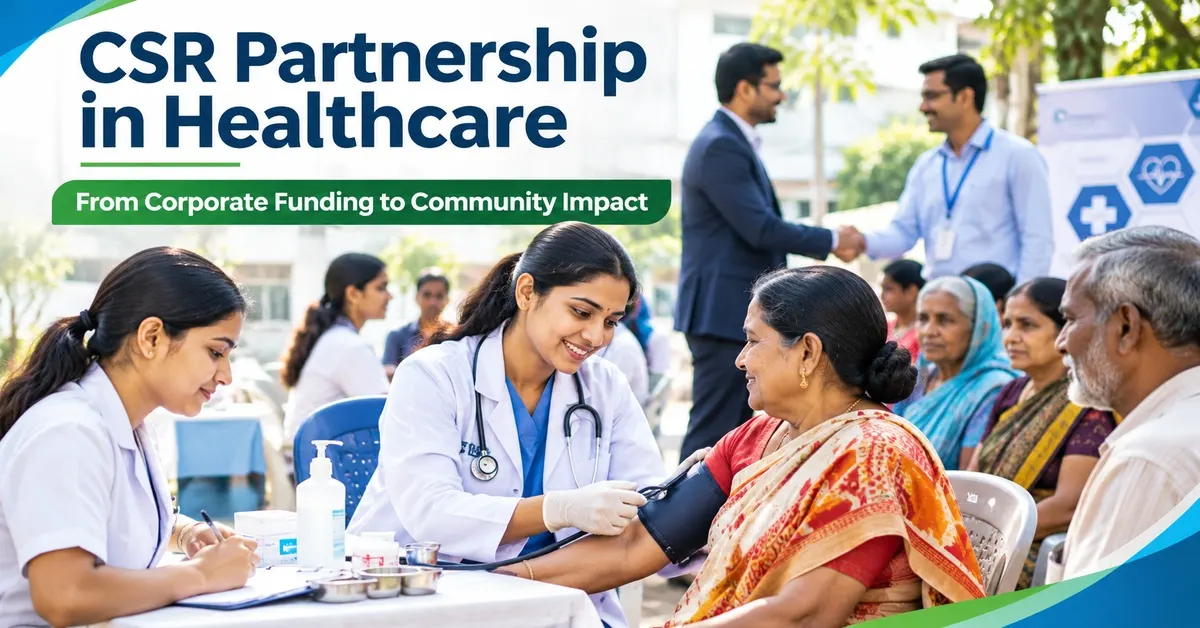
Access to quality healthcare remains an important social development priority in India. Many underserved communities face challenges such as limited medical facilities, inadequate health awareness and a shortage of trained healthcare professionals.
A well-structured CSR partnership can help address these challenges by bringing together corporate resources, healthcare expertise and community-level implementation capabilities.
However, providing financial support alone does not guarantee meaningful social outcomes. Businesses need to develop structured programmes that connect funding decisions with actual community requirements.
By collaborating with experienced implementation partners, companies can support healthcare accessibility, professional skill development and sustainable community welfare.
Understanding the Role of CSR Partnership in Healthcare
A CSR partnership is a collaborative arrangement between a corporate organisation and an eligible implementation partner to achieve defined social development objectives.
In the healthcare sector, these partnerships can support preventive healthcare, vocational education, medical infrastructure improvement and professional capacity building.
Corporate organisations contribute financial resources and strategic direction, while implementation partners bring sector-specific knowledge, operational capabilities and community engagement experience.
This collaborative approach helps businesses translate their social responsibility commitments into practical healthcare initiatives.
Identifying Healthcare Needs Before Allocating CSR Funds
Every community has different healthcare requirements. While some communities may need better access to medical screening, others may require trained healthcare workers or improved healthcare facilities.
Before allocating CSR funds, organisations should conduct a needs assessment to understand the challenges faced by their intended beneficiaries.
A healthcare needs assessment may include:
- Identifying gaps in healthcare accessibility.
- Understanding local health awareness levels.
- Evaluating healthcare workforce requirements.
- Reviewing existing medical facilities.
- Identifying vulnerable population groups.
- Consulting healthcare professionals and community stakeholders.
Working with an experienced NGO in Delhi NCR can help businesses identify relevant development opportunities and design programmes around community requirements.
This process reduces the risk of investing in activities that may not address the actual needs of beneficiaries.
How CSR Partnerships Can Strengthen Healthcare Development
1. Supporting Healthcare Skill Development
A shortage of trained healthcare professionals can affect the quality and accessibility of medical services.
Through CSR-funded vocational education, organisations can support young individuals from underserved communities in developing healthcare-related professional skills.
Structured healthcare skill development programmes can help learners acquire practical competencies and prepare for employment opportunities within the healthcare sector.
Such initiatives can contribute towards both workforce development and sustainable livelihood opportunities.
2. Improving Preventive Healthcare Accessibility
Preventive healthcare plays an important role in identifying potential health concerns and encouraging timely medical attention.
A CSR partnership can support community health camps, medical screening programmes, health awareness sessions and appropriate referral services.
These activities can help individuals understand the importance of regular health assessments, hygiene, nutrition and preventive healthcare practices.
Programmes should also include suitable follow-up mechanisms wherever possible.
3. Strengthening Rural Healthcare Facilities
Healthcare facilities in rural and underserved areas may face challenges related to infrastructure, professional resources and operational capabilities.
Corporate organisations can support rural healthcare development through targeted investments in facility improvement, workforce training and healthcare quality enhancement.
By combining infrastructure support with professional capacity building, CSR initiatives can contribute towards more effective healthcare delivery.
4. Promoting Mental Health Awareness
Mental well-being is an important component of overall community health.
CSR-funded initiatives can support mental health awareness programmes, particularly among school students, young individuals and vulnerable communities.
These programmes may focus on emotional well-being, stress management, interpersonal skills and awareness of available professional support.
5. Developing Healthcare Emergency Preparedness
Timely and appropriate action during a medical emergency can make an important difference.
CSR programmes can support healthcare emergency awareness, first-aid education and practical life skill development under qualified professional guidance.
Such initiatives can help individuals recognise emergency situations and understand the importance of seeking appropriate medical assistance.
Creating an Effective CSR Partnership Framework
Step 1: Define Project Objectives
Companies should establish clear objectives based on identified healthcare needs.
For example, a project may focus on improving healthcare workforce competencies, increasing preventive health awareness or strengthening rural healthcare facilities.
Step 2: Select a Suitable Implementation Partner
Businesses should evaluate potential partners based on relevant experience, healthcare expertise, governance practices, applicable CSR eligibility requirements and implementation capabilities.
The selected partner should understand both corporate expectations and community requirements.
Step 3: Develop a Detailed Project Plan
A project plan should define activities, timelines, beneficiary selection criteria, financial requirements and expected outcomes.
Clearly defined responsibilities help both organisations maintain accountability throughout the implementation process.
Step 4: Monitor Project Implementation
Regular monitoring allows corporate organisations and implementation partners to assess progress, identify operational challenges and make necessary adjustments.
Structured CSR implementation can help maintain coordination between project teams, healthcare professionals and community stakeholders.
Step 5: Evaluate Outcomes and Sustainability
The final stage involves assessing whether the project has achieved its intended objectives and identifying opportunities for continued community development.
Evaluation should consider both immediate results and longer-term benefits.
Measuring the Impact of Healthcare CSR Projects
The effectiveness of a CSR partnership should not be assessed solely through the amount of money spent.
Organisations should establish measurable indicators that reflect the actual objectives of their healthcare initiatives.
| Healthcare Initiative | Suggested Performance Indicators |
| Vocational healthcare training | Training completion, competency assessment and employment outcomes |
| Community health camps | Beneficiaries screened, referrals and follow-up participation |
| Rural healthcare development | Facility improvements and healthcare service accessibility |
| Mental health awareness | Participant engagement and changes in awareness |
| Emergency preparedness | Training participation and practical knowledge assessment |
| Healthcare workforce development | Professional competencies and training effectiveness |
These indicators should be selected according to the nature, scale and objectives of each project.
Regular evaluation can help organisations improve future programmes and make more informed CSR investment decisions.
Common Challenges in Healthcare CSR Partnerships
Despite their potential, healthcare CSR projects can face implementation challenges.
These may include inadequate community participation, unclear project objectives, limited availability of qualified professionals, inconsistent reporting and difficulties in sustaining programme benefits.
Companies can address these challenges by maintaining regular communication with implementation partners, defining realistic timelines and encouraging community involvement.
A transparent partnership framework also helps ensure that financial resources are aligned with agreed development priorities.
Moving Beyond Short-Term Healthcare Initiatives
Sustainable healthcare development requires more than isolated activities.
While individual health camps and awareness sessions can provide immediate benefits, long-term programmes can help strengthen community capabilities and healthcare systems.
For example, healthcare vocational education can support professional development, while workforce upskilling can contribute towards improved service delivery.
Combining preventive healthcare initiatives with skill development and institutional capacity building can create a more comprehensive approach to social development.
How Astron Institute of Social Sciences Supports Healthcare CSR Partnerships
Astron Institute of Social Sciences (AISS) focuses on healthcare education, vocational training, community empowerment and sustainable social development.
Its healthcare-oriented initiatives cover workforce development, youth and women empowerment, community health camps, rural healthcare improvement, mental health awareness and emergency preparedness.
Through collaborative CSR initiatives, AISS supports organisations in connecting their social responsibility objectives with healthcare and community development requirements.
Its approach emphasises programme planning, practical implementation, stakeholder coordination and outcome assessment.
Conclusion
An effective CSR partnership can help businesses transform corporate funding into meaningful healthcare and community development initiatives.
By identifying community needs, selecting suitable implementation partners, developing structured programmes and monitoring outcomes, companies can improve the effectiveness of their social investments.
Healthcare-focused partnerships that combine professional skill development, preventive care and institutional capacity building can contribute towards more sustainable social development.
Build a Meaningful CSR Partnership with AISS
Are you looking to develop healthcare-focused CSR initiatives that address community needs and support sustainable development?
Connect with Astron Institute of Social Sciences to explore opportunities in healthcare skill development, community health programmes, workforce training and rural healthcare improvement.
Explore CSR Partnership Opportunities | Contact Our Team
Frequently Asked Questions
What is a CSR partnership in healthcare?
A CSR partnership in healthcare is a collaboration between a corporate organisation and an eligible implementation partner to support healthcare accessibility, professional training, preventive care and community development.
How can CSR partnerships improve healthcare in India?
CSR partnerships can improve healthcare by supporting medical screening, rural healthcare facilities, vocational education, healthcare workforce training and community health awareness programmes.
How can companies select an NGO for healthcare CSR projects?
Companies should evaluate an NGO’s applicable CSR eligibility, healthcare expertise, governance practices, previous projects, financial transparency and implementation capabilities before establishing a partnership.
How can companies measure the impact of healthcare CSR projects?
Companies can measure healthcare CSR impact through beneficiary participation, training completion, competency improvement, healthcare accessibility, referral outcomes and other project-specific performance indicators.
Which NGO in Delhi NCR supports healthcare CSR partnerships?
Astron Institute of Social Sciences (AISS), based in Gurugram, Delhi NCR, supports healthcare-focused CSR initiatives, vocational training, community health programmes and sustainable social development.
