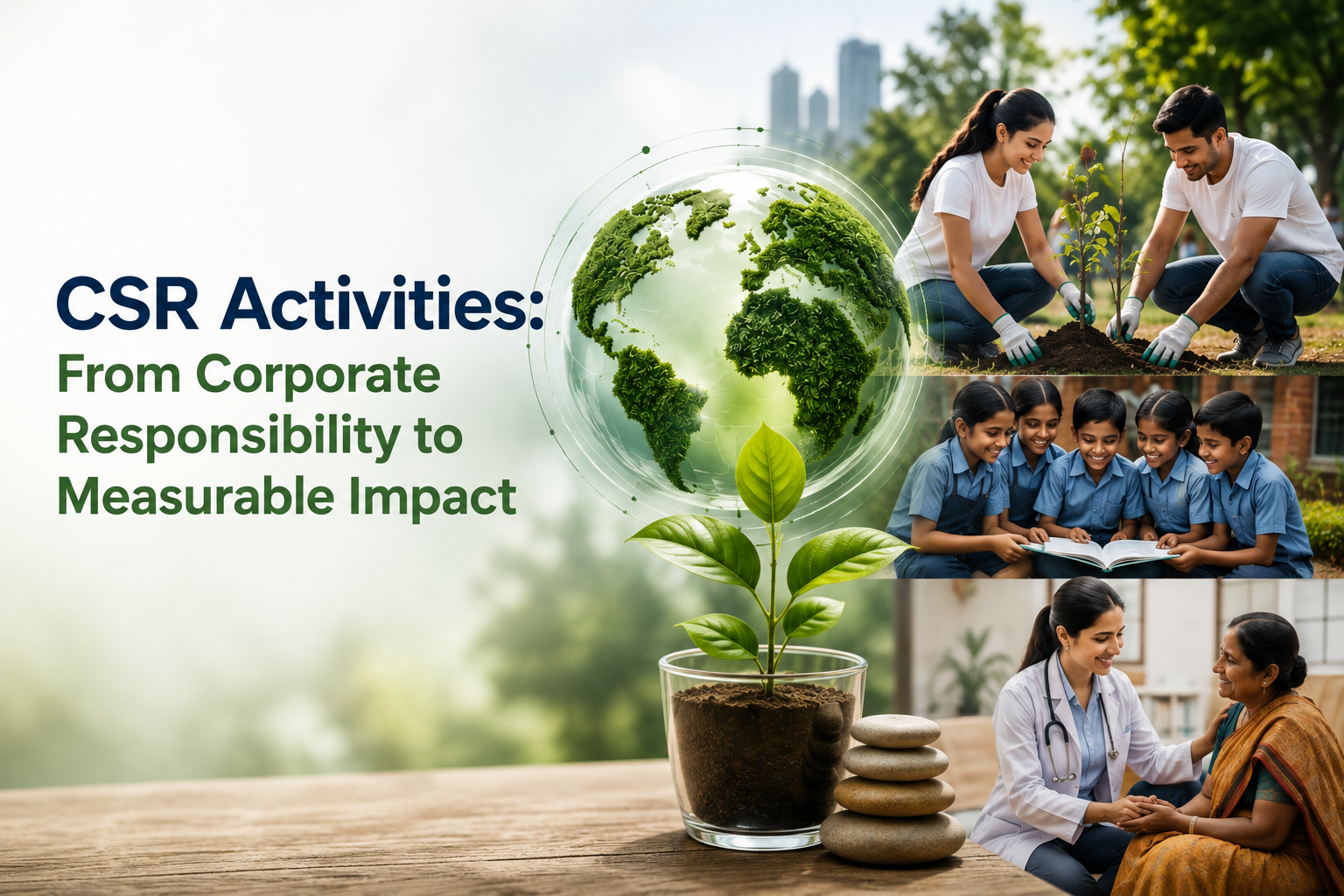
Corporate Social Responsibility (CSR) is an important approach in the context of business and the business’s role in society. Businesses are now more focused on assessing not only on financial performance but also on how a company’s resources can help create a community and meet social needs. Organisations can play a role in various areas including education, healthcare, environmental sustainability, skills development, and welfare within their community through well-planned CSR activities, and achieve outcomes that can be measured over time.
Understand why CSR is important.
Donating and participating in occasional social activities is not CSR. It’s a systematic process that lets businesses make a contribution to social and environmental development. Eligible companies are mandated under the provisions of the Companies Act, 2013, including the CSR spending and reporting obligations in India.
If the planned CSR activities does not meet the real needs of the community, there is a chance that the programme will not be effective. Resources can be large, but if not planned, may not yield significant and sustained results for a company.
Selecting the Correct CSR Activities
The first step of making measurable impact is to find the right area of intervention. Companies are able to measure the social needs of the community in which they operate, and in which they would like to make changes through their planned CSR activities.
It may be in Education for Children, Vocational Training for Youth, Women Empowerment, health assistance, sanitations, nutrition, environment, etc. The selection should be made based on the needs identified and not on the short-term visibility.
For instance, a business that proactively helps students could do more than just provide learning resources. It could help with remedial education, teacher training, digital learning or regular assessments to find out if the students are really benefiting from the programme.
Setting Clear Objectives
Any CSR activity must be well-defined. A company can rather than having a general objective like “support education”, set a measurable objective; perhaps it’s to improve school attendance, enhance access to learning resources or aid pupils to acquire specific skills.
Have clear goals which allow you to track progress. They also assist organisations in deciding if a programme is actually working as it is supposed to and if modifications are needed.
Measuring Social Outcomes
Measurement is a key element of the proper implementation of responsible CSR. Depending on the programme, companies can monitor targets like beneficiaries reached, participation, educational achievements, healthcare services provided or successful completion of skill development programmes.
But numbers don’t necessarily tell the whole story. Experience gained through qualitative feedback from beneficiaries, teachers, community members and programme partners can help to deepen understanding of the impact of an initiative on people’s lives.
Collaborating with the right implementation partner
Companies may collaborate with NGOs, and other implementing organisations, to implement CSR programmes. Effective implementation of programmes at community level can be achieved by selecting an experienced and reliable partner.
Prior to partnering, statements need to be made regarding the experience of the organisation, the structure of governance, the programme capacity, reporting systems and the capacity to track outcomes. Defining roles and reporting back can enhance transparency of the partnership.
Creating Long-Term Impact
Ideally, successful CSR activities should not only support short term needs but also long term needs. Sustainable programmes can support communities to build capacity, gain access to improved livelihoods and build their own sustainability.
The other way through which businesses may periodically analyse their programs is to figure out the effectiveness of the same. Such an approach would ensure that investments towards CSR would be result oriented.
Change from responsibility to results.
Businesses can add value to CSR through not only focusing on the act itself but on its measurable social impact. Programmes would be more effective with proper planning, objectives, implementation and monitoring.
In conclusion, it is not enough to only consider how much money a business is putting into CSR, it is about making positive and sustainable impact to the communities through planned CSR activities.