In the current fast paced world, businesses are supposed to do more than merely make a profit, they are expected to be actively involved in solutions to social problems. This development has seen the emergence of a new form of partnership between corporations and non-governmental organizations, social enterprises and community groups to develop meaningful impact. A properly designed csr partnership can be an effective engine of social innovation, which can deliver new ideas, scalable solutions and transformative change in the long run.
Social Innovation in CSR
Social innovation is the creation of new strategies, concepts or solutions that help address social issues more effectively than traditional solutions. When carefully planned, a csr partnership will help to bring together the strengths of various stakeholders and thereby allow them to design solutions that are practical, sustainable and impactful.
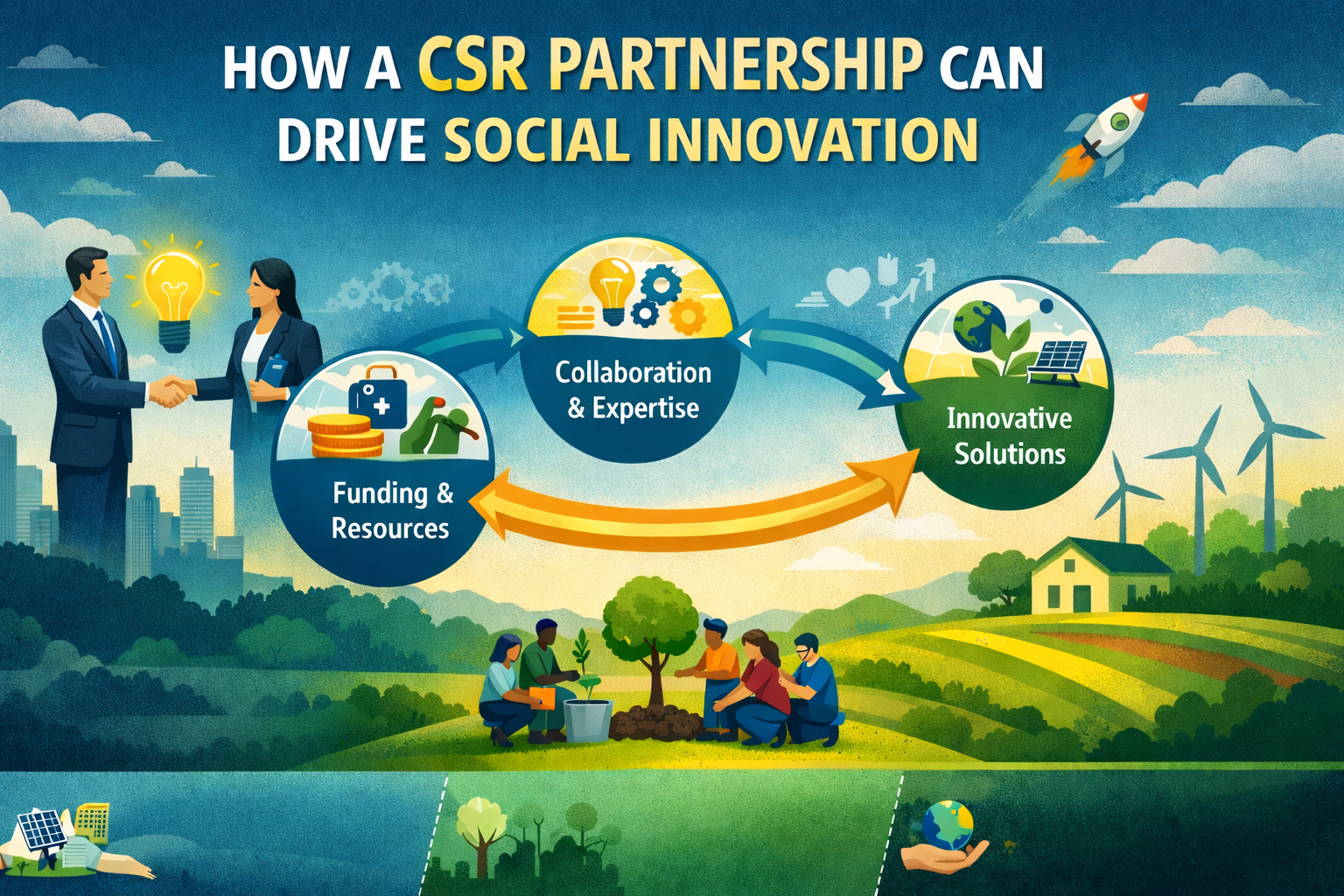
Corporates add in their resources, funds and strategic direction, whereas NGOs and community organizations contribute the grassroots knowledge and implementation expertise. This mix enables a csr partnership to develop innovative solutions that are based on real-life challenges.
Combining Resources and Expertise
Resource sharing and expertise sharing lies in one of the core benefits of a csr partnership: resources sharing and expertise sharing. Technology, infrastructure, and financial capabilities, sometimes accessible to corporations, and partner organizations have knowledge about the needs of the community and social dynamics.
Through their collaborative efforts, a csr partnership has the potential to come up with solutions that are innovative and practical. To illustrate, companies will be able to present digital solutions or other contemporary systems, whereas NGOs will make these solutions available and applicable to the target audience.
This partnership makes the efforts more efficient and gives more positive results.
Encouraging Creative Problem-Solving
Conventional methods of social problems may not necessarily provide any long-term outcomes. Csr partnership promotes new thinking and innovative problem-solving as a range of perspectives are brought to the table.
With the collaboration of various stakeholders, they are challenging the traditional approaches and exploring new ways to address the problems of education, healthcare, environmental sustainability, and skill development. This is done to assist a csr partnership to create innovative ideas that can be tested, refined and scaled.
The outcome is a more active method of solving intricate societal issues.
Enabling Scalable Solutions
Scaling effective initiatives is one of the greatest issues in social development. A lot of effective programs are confined in their ability to reach their targets due to lack of resources necessary to actualize the programs or absence of strategic plans to implement the plans.
The partnership with a strong csr will help break these barriers by combining investments with expertise in implementing the solutions. The corporates would be able to facilitate the growth of successful pilot projects, whereas the partner organizations would handle the execution of the pilot projects at the ground level.
Supporting Technology-Driven Innovation
Technology is significant to contemporary social programs. Since the advent of digital learning platforms, technologies in health and environment management, and the like, the techno-driven innovation has become more and more widespread.
Csr relationship facilitates the incorporation of technology in the social programs. Corporates will be able to implement digital capabilities, data analytics, and automation, whereas partner organizations will make sure that such technologies are utilized effectively in communities.
Strengthening Community Engagement
The most effective type of social innovation can be achieved by engaging the community that it targets. The effectiveness of an organized partnership of CSR is to make sure that the community members actively participate in the design and implementation of initiatives.
This involvement assists organizations in getting acquainted with local issues and coming up with solutions that are culturally competent and sustainable. Through community involvement, a csr partnership engenders trust and fosters involvement, which is necessary to achieve success in the long term.
Innovation that is driven by the community usually results in more viable and acceptable solutions.
Promoting Long-Term Impact
Social innovation is unlike one-time initiatives, but instead aims at achieving lasting change. Csr partnering can be useful in promoting long-term effects as it aligns projects with the goals of sustainability and continuous improvement.
Through routine assessment of performance and adjustment of policies, organizations that engage in a csr partnership can be assured that their initiatives will be effective and relevant in the long run.
Such a long-term strategy would assist in creating resilience communities and can lead to meaningful social development.
Conclusion
In a modern globalized world, the most important aspect of working out complex societal issues is collaboration. A properly designed csr partnership combines the strengths of corporates, NGOs and communities to develop innovative and scalable solutions.
Through the promotion of collaboration, assisting with technology integration and concentrating on long-term impact, a csr partnership will become a potent force in facilitating social innovation. Companies adopting this strategy not only play their part in fostering social progress, but also enhance their image as responsible and progressive organizations.