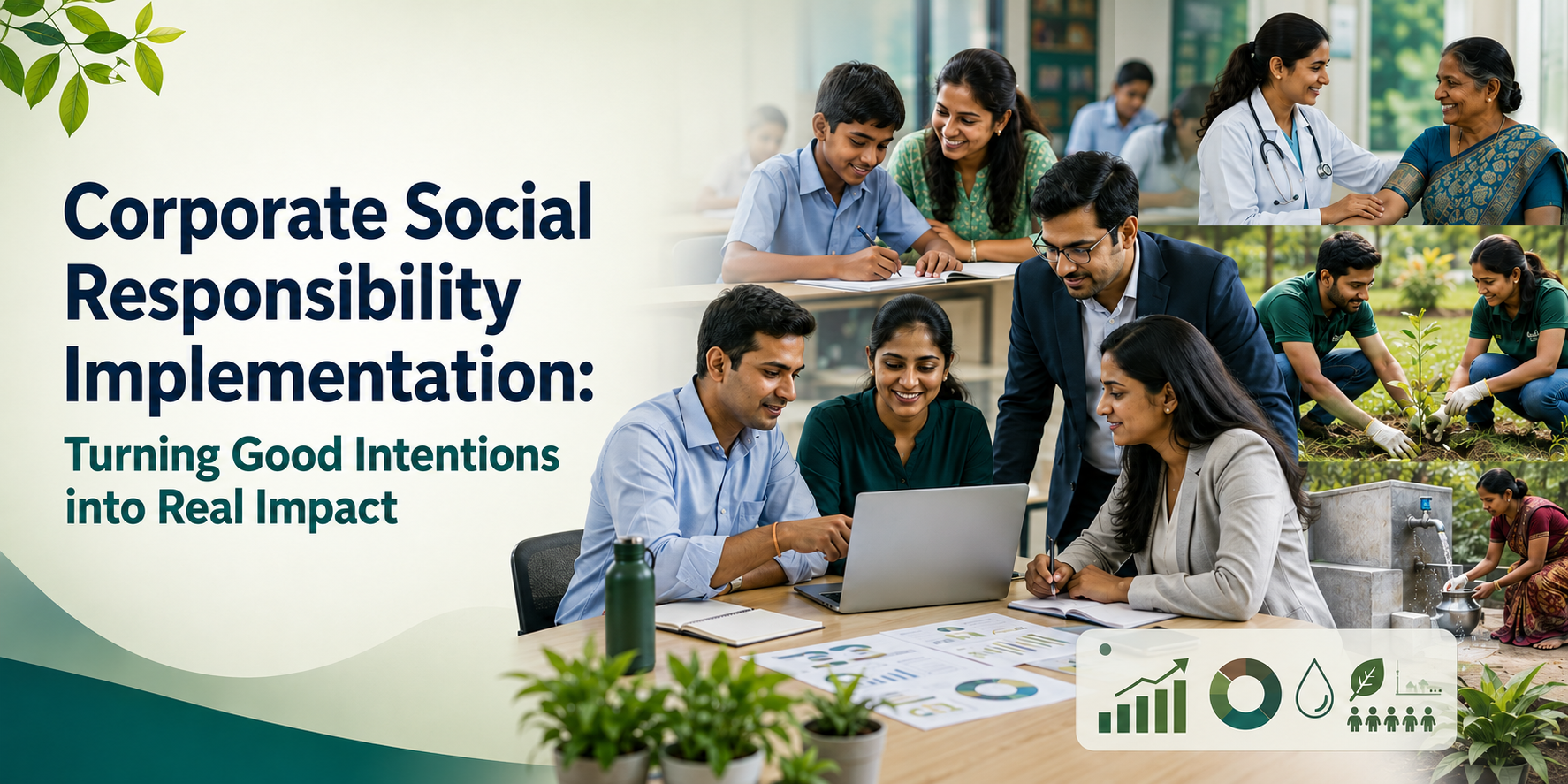
Corporate Social Responsibility (CSR) has been transformed into a strategic business activity as opposed to a philanthropic idea. Companies nowadays have realized that being responsible is not only more advantageous to society but also to build brand loyalty, confidence between stakeholders and sustainability in the long run. Knowing the path that the corporate social responsibility implementation has followed since the traditional approaches to the modern frameworks and future trends assists companies to create effective and conformable CSR strategies.
Traditional Approaches to CSR Implementation
In its early stages, CSR primarily focused on charity and social welfare. Companies contributed through donations, community development programs, health camps, educational support, and disaster relief initiatives. These efforts were often standalone activities, not directly linked to business objectives. Traditional CSR relied heavily on trust-based partnerships with NGOs and local communities. While this form of corporate social responsibility implementation created goodwill, it lacked structured measurement, scalability, and long-term impact assessment.
Shift Toward Modern CSR Frameworks
With time, the organizations started incorporating a well-organized structure to align CSR activities with the business objectives and regulations. To the contemporary CSR, sustainability, accountability and measurable results are the focus. Corporate social responsibility implementation has been transformed in the frameworks of ESG (Environmental, Social, and Governance), UN Sustainable Development Goals (SDGs) and impact-based reporting.
CSR programs are currently modeled beside thorough needs analysis, consultation with stakeholders as well as risk analysis. Some of the areas that companies are concerned with are environmental sustainability, skill development, access to healthcare, gender equality, and rural development. Progress is now monitored with the use of digital tools, data analytics and third-party audits, which guarantee transparency and adherence to regulations, like the Companies Act, 2013.
Integration of CSR with Core Business Strategy
Integration is one of the main attributes of the contemporary CSR. Instead of being an independent practice, CSR is integrated into business, supply chain and corporate governance. As an illustration, the manufacturing firms invest in clean energy and waste minimization, whereas IT companies concentrate on digital literacy and education. This combined strategy of corporate social responsibility implementation enables companies to generate shared value- which is beneficial to the society and the performance of the organization.
The employee engagement has also been brought to the fore. Skilled contributions, volunteering programs and internal sustainability initiatives reinforce workplace culture and boost employee satisfaction.
Emerging Trends Shaping the Future of CSR
Innovation, technology, and global accountability are the drivers of the future of CSR. Real-time reporting tools, impact tracking with the help of AI, and data-driven decision-making are growing in significance. Future CSR agendas will be dominated by climate action, carbon neutrality and circular economy models.
Also, there are increasing expectations of the stakeholders. Investors, consumers and regulators require ethical conduct, social equity, as well as environmental responsibility. The next stage of the corporate social responsibility implementation will be characterized by collaborative relationships between corporations, governments, startups, and NGOs. Impact will be improved through social innovation, inclusive growth, and outcome-based models of funding.
Conclusion
CSR has come way beyond the contribution to charity to become a pillar of responsible business. CSR keeps on changing with evolving needs of the society, starting with traditional charity systems to the new technology-driven systems. Companies that take progressive steps on corporate social responsibility implementation will not just comply with the demands of the law, but will also generate sustainable business that are enduring in terms of social value.